

The Structural Logic Behind Mortise and Tenon Joinery
1. Interlocking Wood Rather Than Mechanical Fasteners
Mortise and tenon joinery functions through precision-cut interlocking wood components. A tenon extension fits tightly into a corresponding mortise cavity, forming a connection that relies on compression and friction rather than screws or bolts.
This method has been widely used in timber framing and furniture construction for centuries. Unlike metal fasteners, which rely on concentrated pressure at specific points, the mortise and tenon joint distributes structural load across the wood itself.
According to the UK’s Timber Research and Development Association, properly designed timber joints can provide long-term structural strength when correctly executed and maintained. The principle remains consistent whether applied to buildings or furniture.
2. Load Distribution and Frame Integrity
When weight is applied to a bed, stress travels through its joints. In a bolted frame, this stress is concentrated at the hardware. Over time, repeated loading can create slight movement around those connection points.
In a mortise and tenon system, weight is absorbed across a broader contact surface. This unified load distribution strengthens overall frame integrity and reduces the risk of gradual loosening.
Why Traditional Metal Fastener Frames Develop Movement
Bolt Compression and Gradual Loosening
Metal fasteners are effective in short-term assembly, but they depend on torque and tension. As materials respond to temperature changes and repeated use, bolts may require retightening to maintain stability.
The UK’s Institute of Wood Science notes that timber and metal expand and contract at different rates. In mixed-material structures, these differences can contribute to long-term stress at connection points.
Over time, even small variations can lead to audible creaking or subtle instability.
Friction and Noise
Noise in bed frames often results from micro-movement where metal meets wood or metal meets metal. As components shift slightly under weight, friction generates sound.
In contrast, a properly fitted wooden joint minimises separate moving parts. The absence of metal hardware significantly reduces friction points, leading to quieter performance during daily use.
--altImgStart--{"link":"https://s3.springbeetle.eu/dev-de-s3-flexispot/commodity/item/Screenshot%202026-01-30%20145116_20260226_dPBDdOP3.png","alt":"Japandi Solid Wood Bed Frame (Kana)"}--altImgEnd--
How Interlocking Joints Enhance Real-Life Performance
Stability During Repeated Use
Beds experience dynamic movement rather than static loads. Getting in and out, turning during sleep, and shifting weight all introduce repeated stress.
A mortise and tenon bed responds to this dynamic pressure through its integrated structure. Because the frame behaves as a cohesive unit rather than separate pieces connected by bolts, it resists cumulative loosening.
Long-Term Structural Alignment
Frame alignment plays an important role in mattress support. Uneven stress at joints can cause slight sagging or misalignment over time.
Research published through the Building Research Establishment highlights the importance of structural continuity in load-bearing timber systems. While often applied to larger constructions, the same principle holds true at furniture scale. Consistent alignment contributes to stability and longevity.
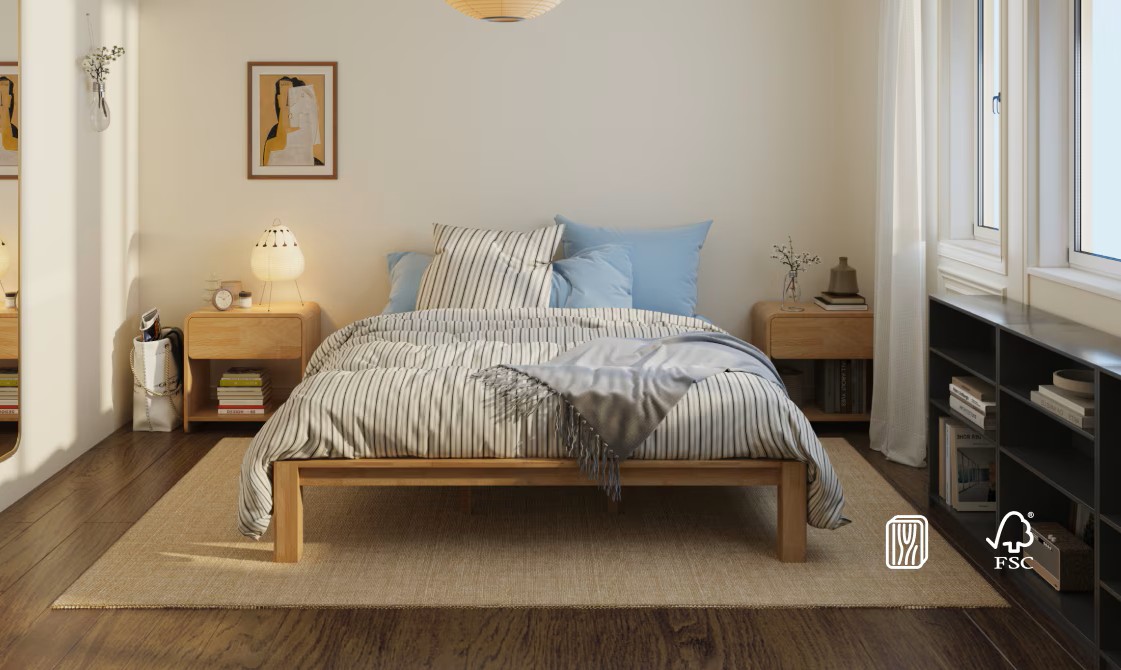
A modern example is the Japandi Solid Wood Bed Frame. As a solid wood bed frame designed with Japanese-inspired mortise and tenon joinery, it prioritises structural cohesion. By eliminating visible mechanical fasteners at critical load points, the frame maintains stability through integrated wood connections rather than bolt tension.
--altImgStart--{"link":"https://s3.springbeetle.eu/dev-de-s3-flexispot/commodity/item/Kana-img1-3_20260104_BprJcP9o.png","alt":"Japandi Solid Wood Bed Frame (Kana)"}--altImgEnd-- --shopstart--{"id":10010009,"link":10010009,"name":"Japandi Solid Wood Bed Frame","shortName":"Kana","url":"https://s3.springbeetle.eu/dev-de-s3-flexispot/commodity/item/1028_file_20251022-074841.542-4.png","itemFootMarkType":"NEW"}--shopend--
Structural Differences in Everyday Context
Assembly Precision Versus Mechanical Tightening
Traditional frames often rely on user assembly and bolt tightening. Stability depends partly on how securely each fastener is installed.
Mortise and tenon systems shift that responsibility to design precision. When manufactured accurately, the joint itself determines stability rather than the amount of force applied during assembly.
Material Compatibility
Wood-to-wood connections behave differently from mixed-material connections. Because both components share similar expansion characteristics, the structure adjusts more uniformly to environmental changes.
This compatibility reduces internal stress, which can otherwise accumulate in frames combining metal brackets and timber rails.
--altImgStart--{"link":"https://s3.springbeetle.eu/dev-de-s3-flexispot/commodity/item/image_20260226_nVqzsIQY.png","alt":"Japandi Solid Wood Bed Frame (Kana)"}--altImgEnd--
Is Mortise and Tenon Always Superior?
Quality of Craftsmanship Matters
Not all wooden joints are equal. Precision cutting and proper engineering are essential to achieving full stability benefits.
Poorly fitted joints can create gaps, undermining structural integrity. Reputable manufacturers ensure tight tolerances and quality control.
Intended Use and Budget Considerations
Metal fastener frames may still suit temporary living situations or short-term use. They are often lighter and less expensive.
Mortise and tenon beds are better suited to buyers prioritising long-term structural reliability and reduced maintenance over initial cost savings.
Final Thoughts
Japanese mortise and tenon beds are more stable than traditional metal fastener frames because they rely on integrated wood connections rather than mechanical tension. By distributing load across interlocking joints, they reduce micro-movement, minimise noise, and maintain alignment over time.
For buyers seeking a solid wood bed frame engineered for lasting stability, mortise-and-tenon construction offers structural logic grounded in centuries of craftsmanship. Its strength lies not in complexity, but in precision and cohesion.
In practical terms, stability is often something only noticed when it is missing. A frame that remains aligned, quiet, and structurally consistent over years of use rarely draws attention to itself. That unobtrusive reliability is often the result of thoughtful engineering rather than visible complexity. Mortise and tenon construction prioritises structural unity over mechanical tightening, which can translate into fewer adjustments and less ongoing maintenance. For buyers who value consistency and longevity in everyday furnishings, this type of joinery offers a measured, practical advantage rooted in craftsmanship rather than convenience.


_20260602_cc9a7609.png)


