


Understanding How Mortise and Tenon Joinery Works
1. The Structural Principle Behind the Joint
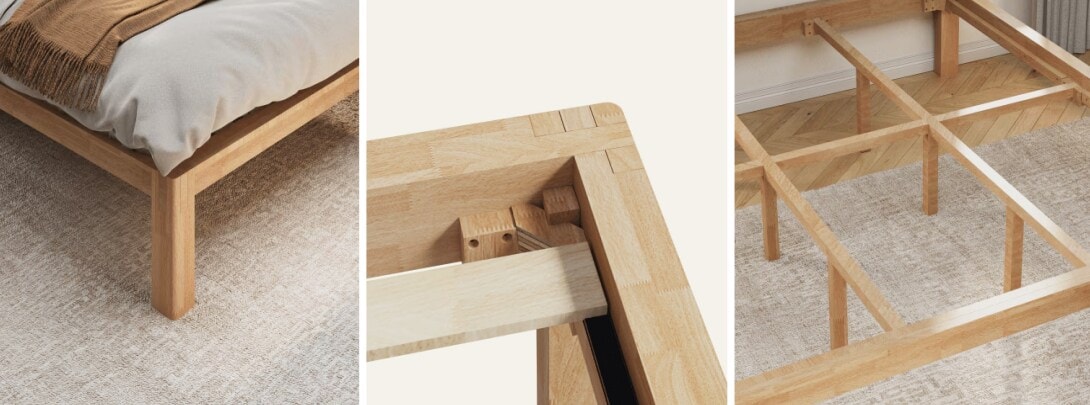
Mortise and tenon joinery connects two pieces of wood through a precisely cut interlocking system. A projecting tenon fits tightly into a corresponding mortise cavity, creating a secure connection without relying on screws, brackets, or external hardware.
This technique has been widely used in traditional architecture and furniture making for centuries. The interlocking structure distributes weight evenly across the wood, forming a cohesive frame rather than a collection of separate parts.
The durability of this method is well documented in timber construction history. The UK’s Institute of Historic Building Conservation notes that traditional joinery methods were designed for longevity and structural resilience, particularly in timber-framed buildings that have endured for generations.
2. Why No Metal Fasteners Matter
Modern bed frames frequently rely on bolts or brackets to secure corners and rails. Over time, repeated movement and weight can cause these components to loosen, leading to instability or noise.
Mortise and tenon systems avoid this problem by eliminating metal stress points. The joint relies on precision and compression rather than torque from fasteners. When properly engineered, the structure becomes stable under load rather than weakened by it.
Stability and Noise Reduction in Everyday Use
Reducing Micro-Movement
A common issue with conventional frames is subtle movement at connection points. Even small shifts can create friction and eventually lead to creaking.
Interlocking wooden joints minimise this micro-movement. Because the frame behaves as a unified structure, weight is distributed evenly across the entire assembly.
The British Woodworking Federation highlights the structural strength of traditional timber joinery in long-term furniture applications, emphasising that well-crafted wood connections often outlast mechanical fittings.
Supporting a Quieter Sleep Environment
Noise reduction is not only a matter of comfort but also of sleep quality. Research from the UK’s Sleep Council consistently reinforces the importance of a stable and supportive sleep foundation in maintaining consistent rest.
A bed frame constructed with mortise and tenon joinery reduces friction-based sound, supporting a quieter sleep environment. While the mattress plays a primary role in comfort, the structural integrity of the bed frame underpins the entire system.
Long-Term Durability and Material Integrity
How Solid Wood Responds to Time
Solid wood expands and contracts slightly in response to seasonal humidity changes. A joinery system designed to accommodate this movement remains structurally secure without splitting or weakening.
Mortise and tenon joints allow for subtle movement while maintaining strength. This adaptability contributes to long-term performance.
The UK’s Forestry Commission emphasises the environmental benefits of responsibly sourced timber and long-lasting wood products. Choosing durable solid wood furniture supports reduced material waste over time.
Repairability and Lifespan
Another advantage of traditional joinery lies in its repair potential. Unlike frames dependent on proprietary fittings, interlocking wooden structures can often be maintained or restored without replacing entire components.
A bed frame built with long-term integrity in mind offers value that extends beyond the initial purchase price.
A modern example of this approach is the Japandi Solid Wood Bed Frame. As a solid wood bed frame using Japanese-inspired joinery principles, it demonstrates how traditional mortise and tenon construction can be integrated into contemporary design. By prioritising interlocking structure rather than visible metal hardware, it focuses on durability, stability, and understated engineering.
Potential Limitations to Consider
Initial Investment
Mortise and tenon beds often require more skilled craftsmanship and higher-quality timber. This can increase upfront cost compared with mass-produced metal frames.
However, evaluating cost over the lifespan often shifts the perspective. A bed frame intended to last many years may offer better long-term value than replacing lower-cost alternatives.
Weight and Assembly
Solid wood construction typically results in a heavier frame. While this enhances stability, it can make relocation more demanding.
Assembly may also require careful alignment to ensure joints fit precisely. High-quality manufacturing reduces this concern, but precision remains essential.
Design Simplicity
Mortise and tenon beds often favour clean lines and structural clarity over decorative excess. For some buyers, this understated approach is a strength. For others, it may appear minimalist compared with ornate designs.
--altImgStart--{"link":"https://s3.springbeetle.eu/dev-de-s3-flexispot/commodity/item/Kana-img1-2_20260104_xv38TIcU.png","alt":"Japandi Solid Wood Bed Frame (Kana)"}--altImgEnd-- --shopstart--{"id":10010010,"link":10010010,"name":"Solid Wood Bed Frame with Japanese Joinery","shortName":"Kana","url":"https://s3.springbeetle.eu/dev-de-s3-flexispot/commodity/item/1028_file_20251022-074841.542-4.png","itemFootMarkType":"NEW"}--shopend--
When Is It Truly Worth Buying?
For Long-Term Homeowners
Those furnishing a long-term home rather than a temporary space may benefit most from investing in durable construction.
For Light Sleepers
Individuals sensitive to noise often notice the difference in structural quietness. Reduced friction movement can contribute to uninterrupted rest.
For Buyers Focused on Craftsmanship
Consumers who value material integrity and structural logic are likely to appreciate traditional joinery methods.
Mortise and tenon construction is not driven by trend cycles. Its relevance stems from functional performance.
Final Thoughts
A Japanese mortise and tenon bed is worth buying when long-term stability and craftsmanship matter more than short-term convenience. Using interlocking wooden joints rather than mechanical fasteners, it offers structural cohesion, reduced movement, and enduring durability.
Traditional joinery remains relevant because it solves practical problems with elegant engineering. For buyers seeking a solid wood bed frame that balances material integrity with longevity, mortise and tenon construction continues to prove its value over time.
In a market where furniture is often designed for short replacement cycles, traditional joinery offers a different perspective. Rather than prioritising speed of assembly or minimal upfront cost, mortise and tenon construction reflects a commitment to durability and structural clarity. Over time, that approach can feel reassuring rather than indulgent. A bed frame built to remain stable year after year supports not only physical comfort but also a sense of permanence within the home. For those who value longevity over trend, this method represents considered craftsmanship rather than passing style.


_20260602_cc9a7609.png)


